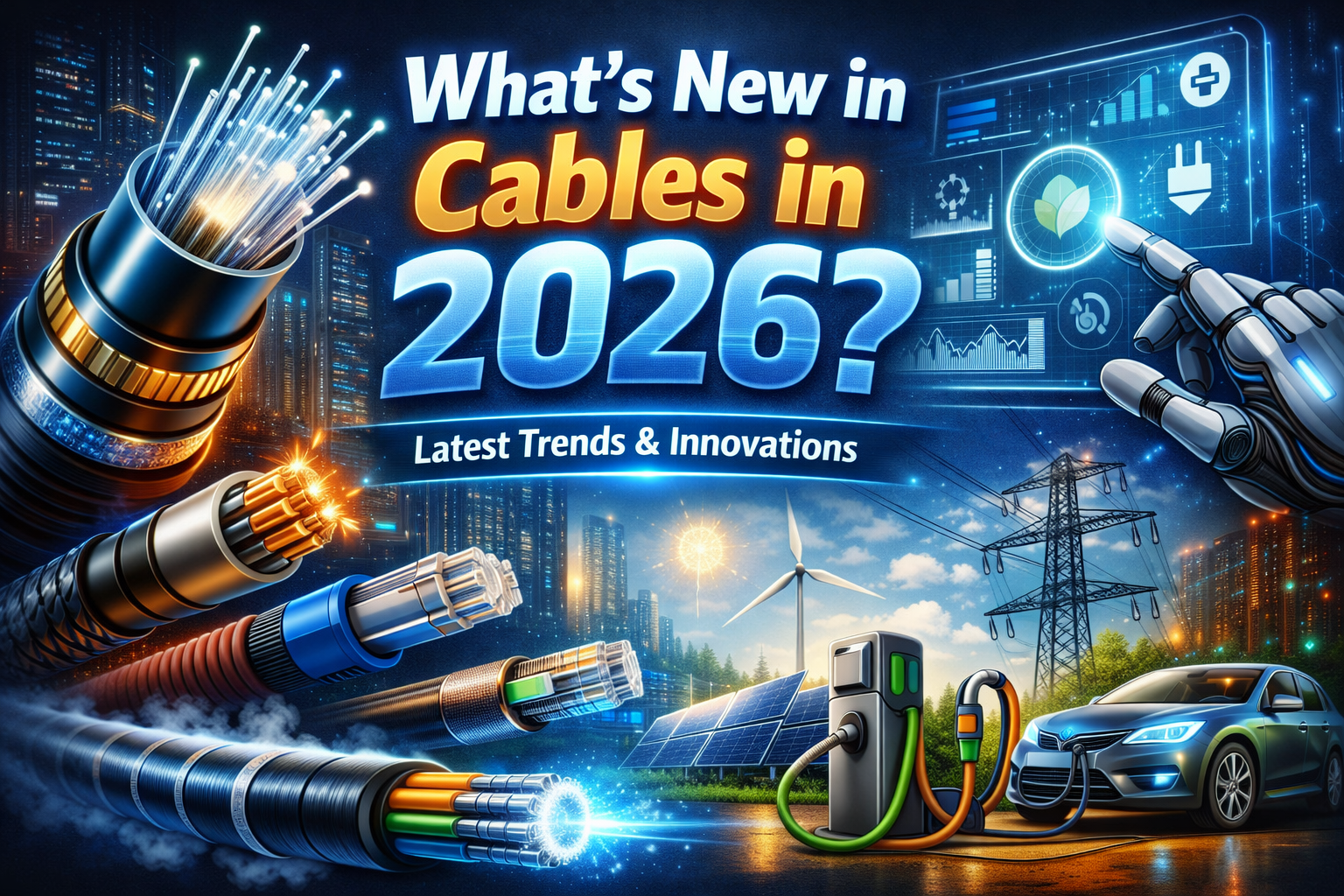
The cable industry in 2026 is evolving rapidly due to the rising demand for high-speed data, renewable energy, electrification, and AI-driven infrastructure. From smarter power cables to ultra-fast optical fibers, innovation is transforming how cables are designed, installed, and used.
Below are the most important advancements shaping the future of cables in 2026.
1. High-Speed Data Cables for AI & Data Centers
One of the biggest drivers of cable innovation in 2026 is the explosion of AI, cloud computing, and data centers.
- New cables now support 800G and 1.6T data transmission speeds, enabling faster communication between servers.
- Data centers are using high-density fiber and advanced interconnects to handle massive workloads.
- Emerging technologies like hollow core fiber (HCF) transmit data faster with lower latency compared to traditional fiber.
👉 Result: Faster internet, smoother cloud services, and more powerful AI systems.
2. Rise of Hollow Core Fiber (Next-Gen Fiber Optics)
A major breakthrough in 2026 is the adoption of hollow core fiber cables.
- These cables send light through air instead of glass
- Offer ~47% faster speeds and lower latency
- Reduce signal loss over long distances
👉 This technology is becoming essential for hyperscale data centers and telecom networks.
3. Smart & Intelligent Cables
Modern cables are no longer “dumb wires.” In 2026, they are becoming smart systems.
- Built-in sensors monitor:
- Integration with AI-driven monitoring systems improves maintenance and prevents failures
- Used heavily in smart grids and industrial automation
👉 Benefit: Reduced downtime and improved safety.
4. Fault Managed Power (FMP) Technology
A major innovation gaining traction in 2026 is Fault Managed Power (FMP).
- Safely delivers higher power over cables
- Automatically shuts down when faults occur
- Recognized in electrical standards (Class 4 power systems)
👉 This allows safer power delivery in buildings, data centers, and industrial systems.
5. High-Power Cables for Electrification & Renewable Energy
With global electrification rising, cable technology is adapting.
- Growth in medium-voltage and high-voltage cables for:
- Renewable energy (solar, wind)
- Electric transport systems
- Smart grids
- Increasing use of XLPE (cross-linked polyethylene) for better insulation and durability
- Expansion of underground and submarine cables
👉 These cables are critical for building modern energy infrastructure.
6. Superconducting Cables (Future Technology)
One of the most exciting developments is superconducting cables.
- Carry electricity with zero resistance
- Reduce energy loss significantly
- Smaller, lighter, and more efficient than traditional cables
👉 Though still developing, they could revolutionize power grids and data centers.
7. Higher Power Delivery (PoE++ & PoX)
Cables are now delivering not just data—but more power than ever.
- Power over Ethernet (PoE) is evolving into higher-power systems (PoE++ and PoX)
- Supports:
- Security cameras
- Smart buildings
- IoT devices
- Requires better heat management and cable design
👉 One cable can now handle both power and data efficiently.
8. Cat6A Becomes the New Standard
In structured cabling systems:
- Cat6A cables are replacing older Cat6
- Support:
- 10 Gigabit speeds
- Higher power loads
- Better performance over longer distances
👉 This is now the preferred standard for modern networks.
9. Sustainable & Eco-Friendly Cable Materials
Sustainability is a major focus in 2026.
- Development of green cables with lower environmental impact
- Use of recyclable and halogen-free materials
- Reduced carbon footprint in manufacturing
👉 Environmental regulations are pushing companies toward greener cable solutions.
10. Pre-Terminated & Easy Installation Systems
Installation is becoming faster and more efficient.
- Pre-terminated cables reduce installation time
- Modular systems improve scalability
- AI tools help optimize cable layout and design
👉 This lowers labor costs and speeds up deployment.
Conclusion
In 2026, cables are no longer simple connectors—they are smart, high-performance infrastructure systems driving the digital and energy revolution.
Key Takeaways:
- Faster data cables for AI and cloud computing
- Advanced fiber technologies like hollow core fiber
- Smart cables with built-in monitoring
- Safer power delivery (FMP & PoE++)
- Growth in renewable energy and high-voltage cables
- Emergence of superconducting cables
- Strong focus on sustainability
👉 The future of cables is centered on speed, intelligence, efficiency, and sustainability, making them a critical foundation for modern technology.