

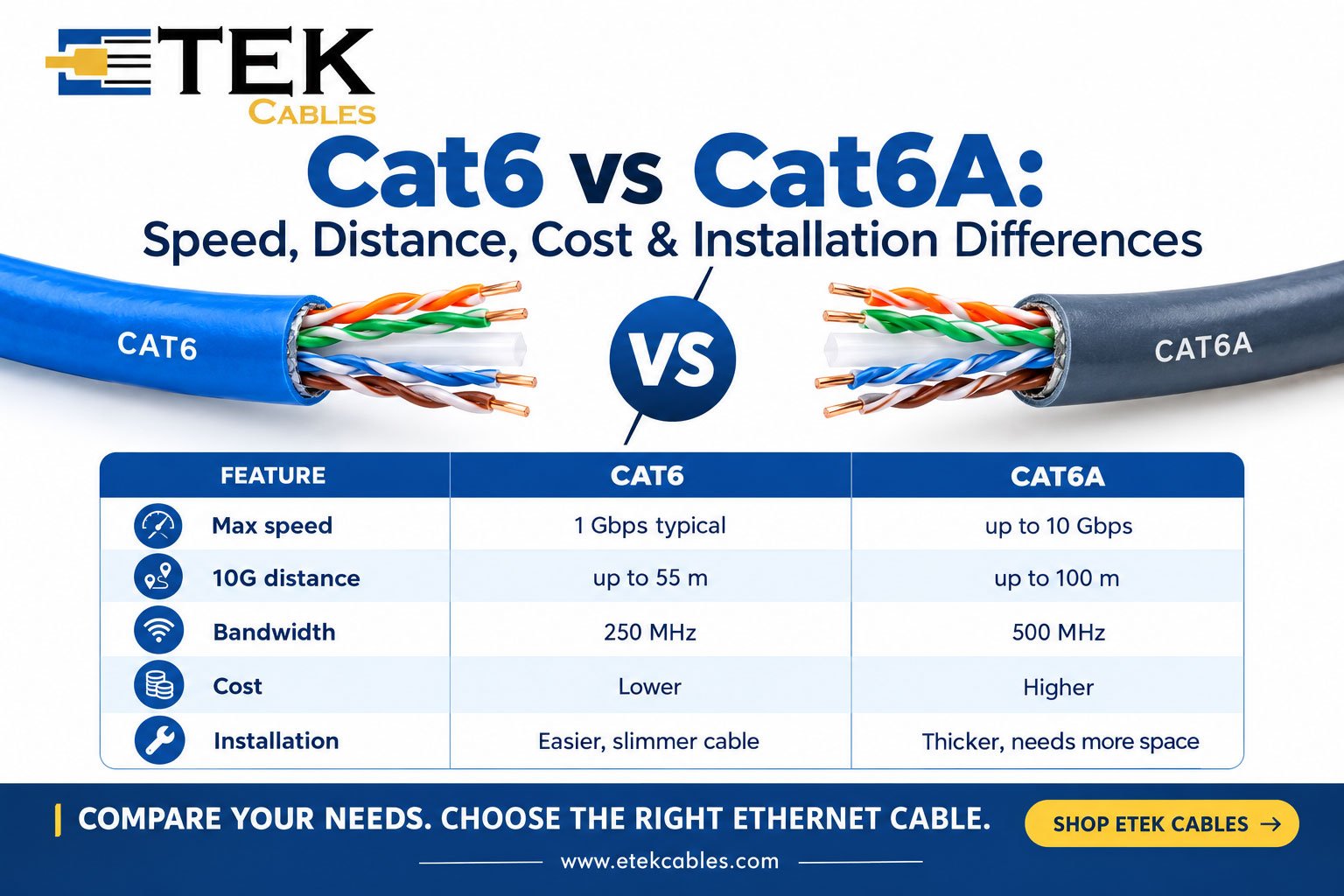
Choosing between Cat6 and Cat6A Ethernet cable can be challenging when planning a home network, office installation, or commercial cabling project. Both cable categories support high-speed Ethernet, but they differ in bandwidth, maximum distance for 10Gbps connections, construction, cost, and installation requirements.
Cat6 is a popular choice for everyday networking because it offers reliable performance at a reasonable price. Cat6A, on the other hand, is designed to provide more consistent 10Gbps performance over longer distances, making it attractive for businesses and infrastructure projects that need room for future upgrades.
Understanding these differences can help you select the right cable without overspending or limiting your network’s future capabilities.
Cat6 vs Cat6A: Quick Comparison
| Feature | Cat6 | Cat6A |
|---|---|---|
| Maximum rated frequency | 250 MHz | 500 MHz |
| Maximum 1Gbps channel distance | Up to 100 meters | Up to 100 meters |
| 10Gbps distance | Typically up to 55 meters under suitable conditions | Up to 100 meters |
| Cable thickness | Generally thinner | Generally thicker |
| Material cost | Usually lower | Usually higher |
| Installation | Easier to route in many situations | May require more space and care |
| Best for | Homes, small offices, general networking | 10Gbps networks, commercial installations, future expansion |
Actual performance depends on cable quality, connectors, installation methods, and the network equipment being used.
1. Speed and Performance
One of the biggest differences between Cat6 and Cat6A is their ability to support 10 Gigabit Ethernet.
Cat6 supports Gigabit Ethernet up to 100 meters and can support 10Gbps Ethernet over shorter distances, commonly up to approximately 55 meters under suitable installation conditions. The exact usable distance depends on factors such as cable quality and interference.
Cat6A, also known as Category 6 Augmented, is designed to support 10Gbps Ethernet across a channel of up to 100 meters. It also provides a higher rated frequency of 500 MHz compared with Cat6’s 250 MHz.
This additional capability makes Cat6A a strong option for environments that need high-speed data transfers, server connectivity, network storage, and demanding business applications.
However, a higher cable category does not automatically increase internet speed. Your router, switch, computer network adapter, and internet service must also support the required performance.
2. Distance: Which Cable Performs Better?
Distance is an important consideration when choosing Ethernet cable.
For standard 1Gbps connections, both Cat6 and Cat6A can support channels up to 100 meters when properly installed. This makes either category suitable for most homes and offices.
The difference becomes more important when you need 10Gbps networking.
Cat6 may support 10Gbps over shorter runs, but performance can be affected by cable length, interference, and installation conditions. For longer runs approaching 100 meters, Cat6A is generally the better choice.
For example, Cat6 may be suitable for connecting a workstation to a nearby network switch. Cat6A is a more practical option when connecting equipment across a large office or between network closets where 10Gbps performance is required.
Remember that the 100-meter limit generally refers to the complete structured-cabling channel, including the permanent link and patch cords, rather than just one cable segment.
3. Cost Differences
Cat6 is usually less expensive than Cat6A. The price difference varies depending on cable quality, length, conductor material, shielding, manufacturer, and supplier.
For a small home installation, Cat6 can deliver excellent value because it supports Gigabit Ethernet and many modern multi-gigabit applications.
Cat6A typically costs more because its construction is designed to meet more demanding performance requirements. It may also require larger cable pathways, compatible connectors, and additional installation labor.
When comparing total project costs, consider more than the price per foot. Installation time, cable management, patch panels, connectors, testing, and future upgrade expenses can all affect the final budget.
If your network only needs 1Gbps or 2.5Gbps, Cat6 may be the more economical option. If you are installing infrastructure for 10Gbps connections over longer distances, the additional investment in Cat6A may be worthwhile.
4. Installation Differences
Cat6 is generally easier to handle because it is often thinner and more flexible than Cat6A. This can make it simpler to route through cable pathways, manage inside network cabinets, and install in residential spaces.
Cat6A cables are often thicker and less flexible due to their construction and requirements for improved resistance to crosstalk. As a result, installers may need more space for cable bundles, wider bends, and careful cable management.
Both categories require proper termination and installation practices. Excessive bending, tightly compressed cable bundles, poor-quality connectors, or improper termination can affect network performance.
Shielded Cat6A systems may require compatible shielded components and appropriate bonding practices. Shielding is not automatically necessary for every installation; the correct choice depends on the environment and design requirements.
For best results, use quality components and have permanent structured cabling installed and tested by a qualified professional.
5. Which Cable Is Better for Homes and Businesses?
Cat6 is a practical choice for most homes and small offices. It provides dependable performance for internet access, streaming, gaming, video calls, smart devices, and many local network applications.
It is also suitable for new installations where affordability and straightforward installation are priorities.
Cat6A is better suited to environments where 10Gbps connectivity over longer copper runs is required or anticipated. Examples include larger offices, server rooms, network storage systems, high-performance workstations, and infrastructure designed for future expansion.
For Wi-Fi access points, cameras, and other Power over Ethernet devices, either category may be appropriate. Check the device’s bandwidth requirements, power needs, cable specifications, and installation conditions before choosing.
In the United States, also confirm that the cable jacket rating and installation method meet applicable building and fire codes. Cable categories alone do not establish code compliance.
6. Is Cat6A Worth the Extra Cost?
Cat6A is worth considering when you need 10Gbps Ethernet over a full 100-meter channel or want additional capacity for future network upgrades.
However, it is not automatically the best option for every project. If your equipment supports only Gigabit Ethernet and your network demands are unlikely to change significantly, Cat6 may provide all the performance you need.
Before deciding, consider your current equipment, expected network growth, cable route lengths, installation budget, and the cost of replacing cabling later.
Planning around actual requirements is usually more effective than choosing the highest category simply because it is available.
Final Verdict
Both Cat6 and Cat6A are capable Ethernet cable categories, but they serve somewhat different priorities.
Cat6 offers a strong balance of cost, performance, and installation convenience for homes and many small businesses. Cat6A provides a clearer path to 10Gbps Ethernet across longer distances and is often the better choice for demanding commercial infrastructure.
Choose Cat6 for cost-effective everyday networking. Choose Cat6A when reliable 10Gbps performance over longer copper runs is a priority.
By matching your cable choice to your equipment, installation environment, and future plans, you can build a network that delivers dependable performance without unnecessary expense.
Plenum vs PVC Ethernet Cable: What's the Difference?
Plenum vs PVC Ethernet Cable: What's the Difference?
Choosing the right Ethernet cable involves more than selecting Cat5e, Cat6, or Cat6A. You also need to consider the cable jacket, especially when installing network wiring inside commercial buildings, offices, schools, or homes. Two common options are plenum-rated Ethernet cable and PVC-jacketed...Cat5e vs Cat6 vs Cat6A: Which Ethernet Cable Should You Choose?
How to Choose the Right Category of Ethernet Cable for Your Network

Top 5 Tips to Upgrade Your Networking Cables for Better Performance

The Evolution and Importance of Ethernet Networking in the Digital Age

What is Ethernet Connectivity?

The Ultimate Guide to Cat6 Plenum Cable Updated Insights