

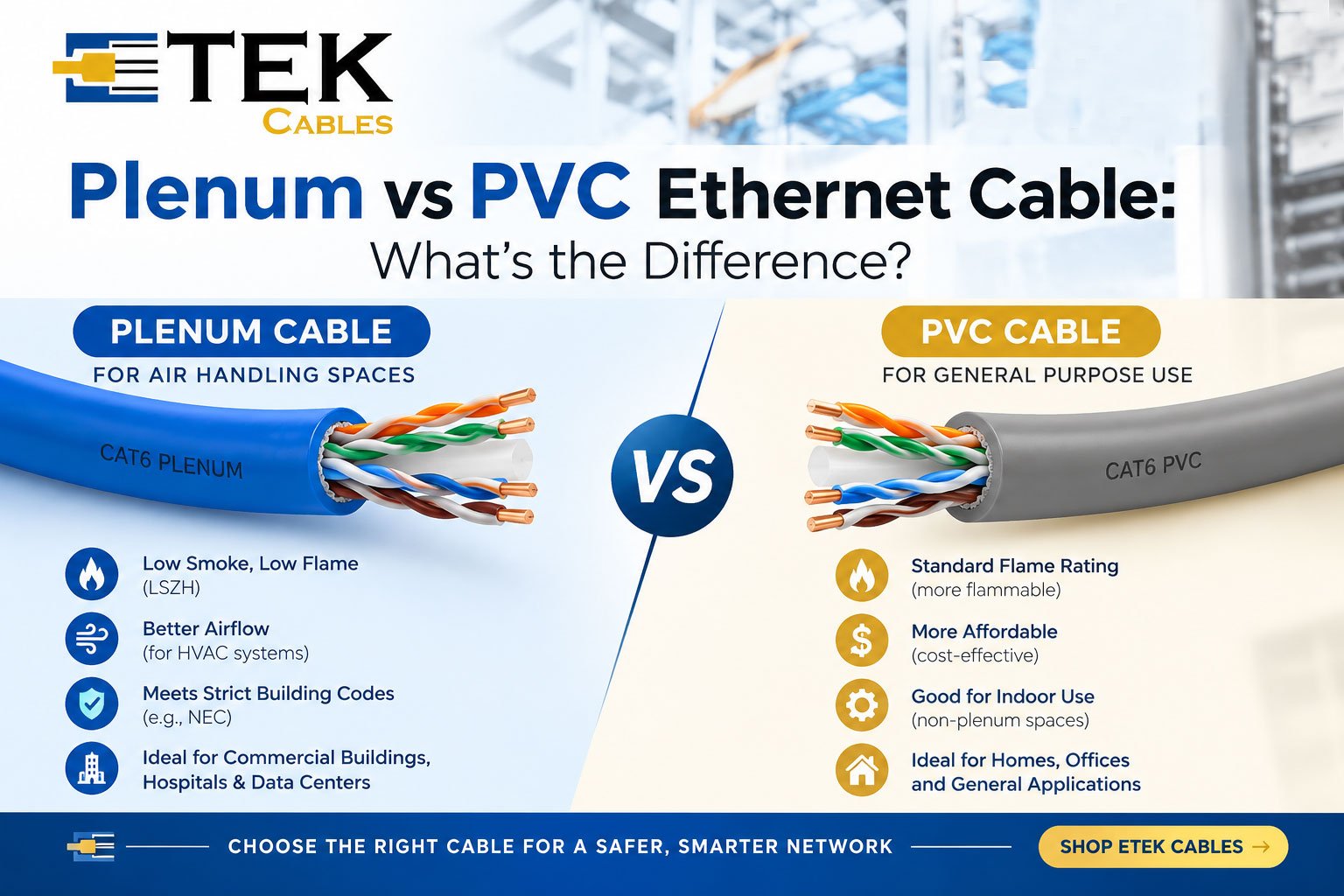
Plenum vs PVC Ethernet Cable: What’s the Difference?
Choosing the right Ethernet cable involves more than selecting Cat5e, Cat6, or Cat6A. You also need to consider the cable jacket, especially when installing network wiring inside commercial buildings, offices, schools, or homes.
Two common options are plenum-rated Ethernet cable and PVC-jacketed cable. The main difference is their intended installation environment and fire-performance characteristics. Plenum-rated cables are designed for use in approved air-handling spaces, while standard PVC-jacketed cables may be suitable for other locations where their specific ratings meet local requirements.
Understanding the differences between plenum and PVC Ethernet cable can help you make a safer, more cost-effective choice for your network installation.
What Is Plenum Ethernet Cable?
Plenum Ethernet cable is designed for installation in spaces used to circulate environmental air as part of a building’s air-distribution system, where the applicable electrical and building codes permit it.
These spaces may include certain areas above suspended ceilings or below raised floors. However, not every ceiling cavity or raised floor is a plenum. The space must meet the relevant building design and code definitions.
Plenum-rated Ethernet cable commonly carries a CMP designation in the United States. CMP cable jackets are designed to meet stringent flame-spread and smoke-production requirements under applicable testing standards.
This matters because a fire in an air-handling space can allow smoke and combustion products to travel through a building. Using cable with the required fire rating helps reduce specific fire-related risks.
Plenum-rated cables often use jacket materials such as specially formulated fluoropolymers or other materials designed to meet the required performance criteria. The exact material depends on the product.
What Is PVC Ethernet Cable?
PVC stands for polyvinyl chloride, a widely used plastic material found in many cable jackets.
PVC-jacketed Ethernet cables are common because they are generally affordable, durable, and suitable for many ordinary networking applications. They are available in different cable categories, including Cat5e, Cat6, and Cat6A.
However, PVC describes a jacket material, not a complete fire-safety rating. A PVC-jacketed cable should not automatically be assumed suitable for every building space.
In U.S. installations, many general-purpose communications cables carry a CM rating, while riser-rated cables carry a CMR designation. These ratings are not interchangeable with CMP.
The correct cable depends on where the cable will be installed and which codes apply. Always check the product’s actual listing and rating rather than relying on the word “PVC” alone.
Plenum vs PVC Ethernet Cable: Key Differences
| Feature | Plenum-Rated Cable | Standard PVC-Jacketed Cable |
|---|---|---|
| Main purpose | Approved air-handling spaces where required | Applications permitted by its specific rating |
| Common U.S. rating | CMP | May be CM or another listed rating |
| Fire performance | Meets stringent plenum flame and smoke requirements | Depends on the cable’s tested rating |
| Typical cost | Usually higher | Often more affordable |
| Jacket material | Specially formulated materials that meet CMP requirements | Often polyvinyl chloride |
| Common applications | Certain commercial ceiling or raised-floor plenums | Suitable residential, office, and other permitted routes |
| Installation choice | Required where applicable codes call for CMP | Suitable only where its rating is permitted |
The exact performance and permitted use depend on the cable’s certification, installation location, and local code requirements.
1. Fire Safety and Smoke Performance
Fire performance is the most important distinction between cable types intended for different building spaces.
Plenum-rated cable must meet the applicable flame-spread and smoke-production criteria for its CMP listing. This makes it appropriate for certain air-handling spaces where ordinary cable may not be allowed.
Standard PVC cable does not automatically meet CMP requirements. Some PVC-based products may have specialized ratings, but the jacket material alone does not prove that a cable is suitable for plenum installation.
Choosing the correct rating helps support the building’s fire-safety design. It is particularly important in commercial buildings, healthcare facilities, educational institutions, and other environments where large numbers of people may occupy the same space.
2. Cost Differences
Plenum Ethernet cable generally costs more than standard general-purpose PVC-jacketed cable.
The price difference comes from material requirements, product testing, certification, and manufacturing specifications. Actual prices vary based on cable category, shielding, conductor quality, length, and manufacturer.
For a small installation in a location where standard-rated cable is permitted, using plenum cable may increase costs without providing a necessary benefit.
However, if the installation location requires CMP cable, choosing a cheaper cable with an unsuitable rating can create compliance and safety problems. The correct rating should be established before comparing prices.
For larger projects, calculate the total cost of the cable, connectors, labor, cable pathways, and testing rather than considering the price per foot alone.
3. Installation and Flexibility
Plenum and PVC-jacketed Ethernet cables can differ in flexibility, outer diameter, and handling characteristics. These differences depend on the specific product rather than the rating alone.
Some plenum cables may be less flexible or more expensive to terminate than comparable general-purpose cables, while other products are designed for easier installation.
Both types should be routed and terminated according to the manufacturer’s instructions. Avoid excessive bending, crushing, or pulling tension, and maintain the required separation from sources of electrical interference where applicable.
For installations involving cable bundles, tight pathways, or complex commercial layouts, consult the product specifications and plan sufficient room for routing and maintenance.
4. Where Should Each Cable Be Used?
Plenum-rated Ethernet cable is commonly selected for approved air-handling spaces where the applicable code requires a CMP rating. Examples may include certain spaces above suspended ceilings or beneath raised floors that are used for environmental air circulation.
Standard PVC-jacketed Ethernet cable may be appropriate for permitted surface routes, equipment connections, and other locations that do not require a higher fire rating. Its actual CM, CMR, or other listing determines where it can be used.
Riser spaces between floors may require a cable with a CMR rating or another permitted wiring method, depending on the building and applicable code. A plenum rating may be acceptable in some locations, but the correct choice should be verified rather than assumed.
In the United States, consult the applicable National Electrical Code requirements, local amendments, and the authority having jurisdiction (AHJ). Requirements can vary according to the space and installation method.
5. Can You Use Plenum Cable Everywhere?
Plenum-rated cable can often be used in locations where a less restrictive cable rating is permitted, provided the product is otherwise suitable for the installation. However, it may be unnecessarily expensive for many ordinary network runs.
The reverse is not true: a general-purpose PVC-jacketed cable should not be installed in a space requiring CMP unless the cable’s actual listing and the applicable rules specifically permit that installation.
Before purchasing cable, identify the route, confirm the required rating, and check the manufacturer’s documentation. When requirements are unclear, consult a qualified cabling installer or local code authority.
Final Verdict
Plenum and PVC Ethernet cables serve different installation needs, and the best option depends primarily on the cable’s required fire rating and intended route.
Choose CMP-rated plenum cable when the applicable code requires it for an air-handling space. Choose a suitable general-purpose or riser-rated cable when its listing is permitted for the installation.
Do not make the decision based on jacket material or price alone. Check the cable’s certification, installation location, and local requirements before buying. Selecting the right cable helps you control project costs while supporting a safe, reliable, and compliant Ethernet network.
Cat6 vs Cat6A: Speed, Distance, Cost & Installation Differences
Cat5e vs Cat6 vs Cat6A: Which Ethernet Cable Should You Choose?

How to Choose the Right Category of Ethernet Cable for Your Network

Top 5 Tips to Upgrade Your Networking Cables for Better Performance

The Evolution and Importance of Ethernet Networking in the Digital Age

What is Ethernet Connectivity?

The Ultimate Guide to Cat6 Plenum Cable Updated Insights